
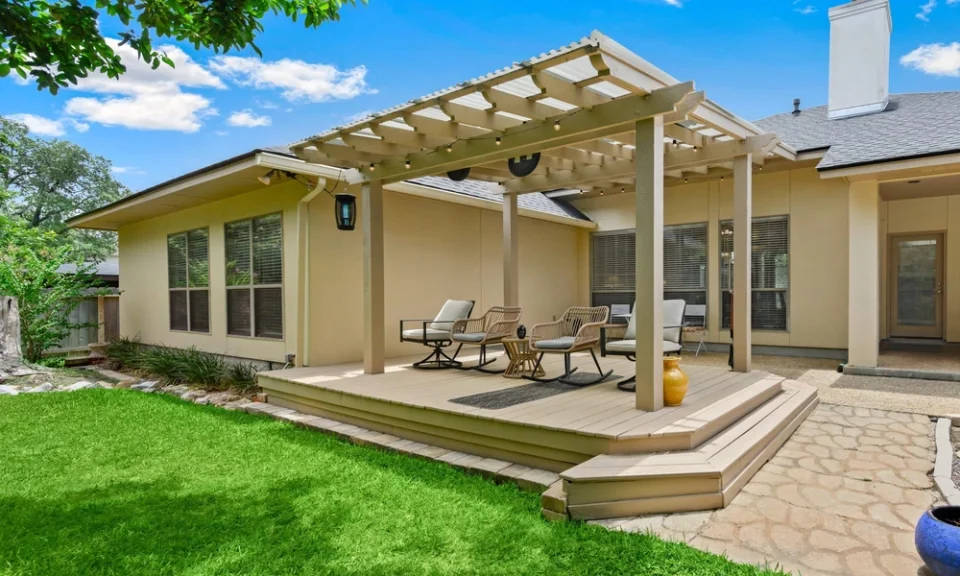
Most homeowners spend about 15 minutes picking a patio cover style and a week second-guessing it. The decision feels deceptively simple until you’re standing in a showroom facing louvered systems, insulated panels, flat-pan covers, and lattice designs, all in different materials, all with very different price tags. Pick wrong and you’re either baking under a structure that lets too much sun through or stuck with a wood cover you reseal every single spring for the next decade.
This guide walks you through the actual decision, not a vague list of options. You’ll learn which cover styles serve which climates, how the three main materials really compare over time, and the one question you need to answer before you talk to any contractor.
Why This Decision Matters More Than You Think
A patio cover is not a decoration. It’s a permanent architectural addition that buyers, appraisers, and your own daily routine will notice for years. Top agents surveyed by HomeLight estimated that a new patio costing $3,269 to construct would bring a $3,563 increase in home value, representing roughly a 109% return on investment, according to a U.S. News Real Estate report. That number climbs further when a covered structure extends the usable hours on the patio through heat, wind, or rain.
The catch? That return depends almost entirely on getting the right cover for your specific backyard. A lattice cover in a scorching Central Valley backyard is not the same investment as a fully insulated solid cover in the same yard. One keeps the space pleasant year-round. The other is essentially a trellis with ambitions.
The Cover Fit Framework: One Question Before You Shop
Before comparing any materials or styles, answer this single question honestly: Do you need shade, shelter, or both?
Shade only means you want filtered light and airflow. You’re comfortable with some rain reaching the patio and you’re not trying to create a true outdoor room. Lattice covers and open-beam pergola styles work here.
Shelter means you want the patio usable even when it’s raining, windy, or intensely sunny. You’re looking for something closer to a covered room than a trellis. Solid insulated covers, flat-pan aluminum systems, or louvered motorized covers fit this need.
Both is the most common real answer, and it typically points toward a louvered cover or an insulated solid panel. You get adjustable airflow on mild days and a sealed roof when the weather turns.
Skipping this question is exactly how people end up with a cover they regret. Don’t let a contractor or a showroom floor skip past it either.
Material Comparison: What Actually Lasts
The three materials you’ll encounter are wood, vinyl, and aluminum. Here’s the honest breakdown.
| Material | Typical Lifespan | Maintenance Level | Best Climate Fit | Aesthetic |
|---|---|---|---|---|
| Wood | 10-20 years | High (annual sealing/staining) | Mild, low-humidity areas | Warm, traditional, customizable grain |
| Vinyl | 20-30 years | Low (rinse and wipe) | Moderate climates, lower UV exposure | Clean, modern, limited color range |
| Aluminum | 30+ years | Very low (annual rinse) | Hot, sunny, high-UV regions | Versatile, can mimic wood grain |
Aluminum patio covers often last 30 years or more with very little deterioration because the structure stays stable without absorbing moisture, while wood typically lasts 10 to 20 years and weakens faster without regular sealing.
My personal take: in any hot, sunny region, aluminum is the right call for almost every homeowner. The maintenance savings alone justify the slightly higher upfront cost. Wood is beautiful and earns its place in certain design contexts, but you’re signing up for a recurring seasonal project that most people quietly stop doing after year three.
Vinyl sits in an awkward middle ground. It’s low maintenance and affordable, but it can become fragile over decades, especially under strong UV rays or shifting temperatures. In a climate with intense summer sun, vinyl tends to show its age before aluminum does.
Cover Styles: Matching the Design to Your Life
Once you’ve nailed down material, style is the fun part. Here’s how the main options actually function in real backyards.
Lattice covers are the most popular entry point. They filter sunlight rather than block it, which keeps the space from feeling dark or cave-like. They’re ideal if you want dappled shade, grow climbing plants, or just want to define the patio area without enclosing it. The trade-off is obvious: rain goes right through.
Solid insulated covers are the workhorses of outdoor living. An insulated panel keeps radiant heat out more effectively than a single-layer solid cover, which matters enormously on a 100-degree afternoon. If your patio faces west and catches the full afternoon sun, this is the cover that makes the space actually usable instead of decorative.
Flat-pan aluminum covers offer a clean, architectural look and solid protection. They’re popular with modern and mid-century home styles because the profile is low and geometric. They handle rain well, and they hold up against wind better than you’d expect.
Louvered covers are the premium option and, honestly, hard to beat in terms of day-to-day versatility. Adjustable louvers let you dial in exactly how much sun and airflow you want. Close them fully and you have a watertight roof. Open them to 45 degrees and you get filtered afternoon light. They’re motorized, so it takes about three seconds to adjust from your phone. The cost is higher, but for homeowners who use their patio daily, the flexibility justifies every dollar.
A Concrete Scenario: The Central Valley Backyard Problem
Picture a standard backyard in a Central Valley city. The patio faces southwest. Summer afternoons push past 100 degrees consistently. The homeowners want to barbecue, let the kids play outside, and occasionally host a dinner party. They’re debating between a lattice cover and an insulated solid cover.
The lattice cover is cheaper and genuinely attractive. But by 3 PM in July, that patio is still unbearably hot because the lattice is filtering light, not blocking radiant heat from the cover itself. The insulated solid cover solves that specifically because the foam core slows heat transfer. By 4 PM, the temperature under the insulated cover is noticeably lower. The family actually uses the patio.
That’s the real-world gap between “good enough” and “right for this situation.” A Patio Cover Builder in Modesto CA who knows the local climate can steer you toward the cover that performs in your specific conditions, not just the one that photographs well in a brochure.
What Outdoor Spending Looks Like Right Now
This isn’t a niche hobby project. Americans spent an estimated $603 billion on home remodeling projects in 2024, according to the National Association of the Remodeling Industry’s 2025 Remodeling Impact Report, and outdoor living continues to rank among the fastest-growing project categories. The demand for covered outdoor spaces specifically has grown as more people treat their backyards as genuine extensions of their living area rather than storage for yard equipment.
That shift in behavior is worth keeping in mind when you’re budgeting. A well-built patio cover isn’t competing with a vacation or a new appliance. It’s adding functional square footage to your home that you use every single week.
Vetting a Contractor: The Three Things That Actually Matter
You can do all the research in the world on materials and styles and still end up with a poor result if the installation is sloppy. According to the 2023 Remodeling Impact Report by the National Association of REALTORS, 92% of Realtors suggest that sellers improve the curb appeal of their home before listing it, which means the quality of the finished project directly affects what buyers perceive and what appraisers note. That quality starts with who builds it.
Three things tell you more than any review:
- They ask about your home’s architecture before recommending a style. A cover that clashes with your roofline or eave height looks wrong no matter how good the material is.
- They pull permits and carry proper licensing. This protects you when you sell and ensures the structure meets local building codes.
- They show you completed projects in similar climates, not just catalog photos. A Modesto summer is not the same as a San Francisco summer, and a contractor who builds in your region knows that.
The backyard you actually spend time in is worth building correctly the first time. Take the Cover Fit Framework question with you to every consultation, and you’ll walk out with a cover that works instead of one that looked great on paper.
